
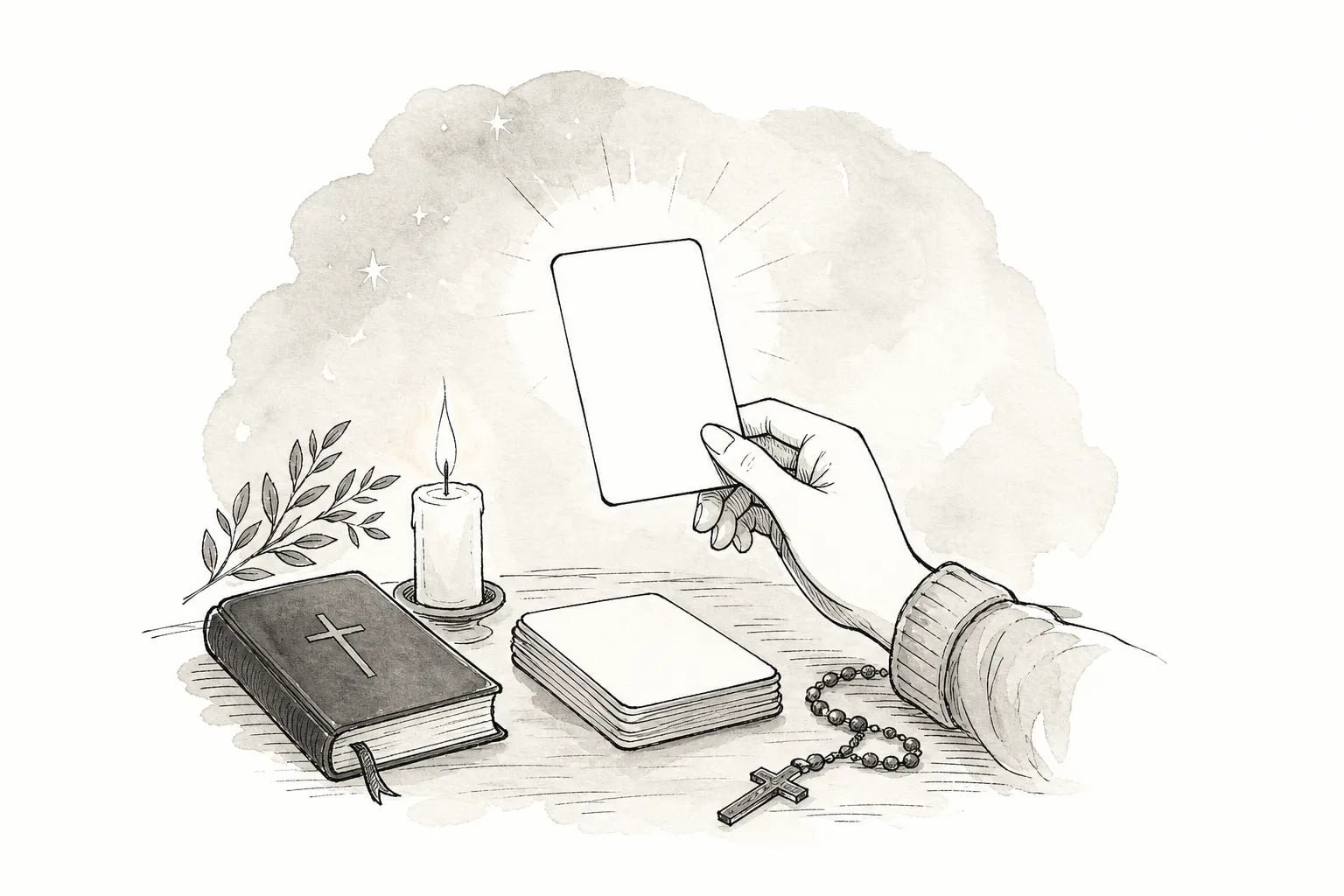
Many Christians arrive at the same uncomfortable crossroads: they’re drawn to card-based reflection, find something meaningful in the archetypal imagery, and then immediately wonder whether they’ve crossed a biblical line. The phrase “Christian tarot cards” lands differently depending on who hears it. For some believers, it raises instant concern. For others, it opens a question they’ve been quietly carrying for years. Both responses deserve a serious, scripture-grounded answer.
This article examines what Christian tarot cards actually are, how scripture and major church traditions address divination, and whether a devotional approach to card-based reflection can stand on solid theological ground. A growing number of scripture-rooted systems, including Biblical Tarot Decks , have emerged specifically to address the friction between card practice and Christian faith. Understanding what those systems are, and what they’re not, is where this conversation has to start.
What Christian tarot cards actually are
How they differ from traditional secular decks
Standard tarot decks, most commonly the Rider-Waite system, were designed in the early 20th century using Western esoteric symbolism: archetypes drawn from astrology, Kabbalah, and numerology. Christian tarot cards replace or reframe that symbolic layer with biblical figures, scripture passages, and Christian theological narrative. The archetypal roles and card positions may stay structurally similar, but the interpretive framework shifts from esoteric tradition to Christian story. That distinction isn’t cosmetic; it changes what you’re actually engaging with when you draw a card.
The role of scripture and biblical symbolism in these systems
The strongest scripture-oriented decks anchor each card to a specific biblical figure or passage rather than a generic archetype. Some, like Robert Place’s “Tarot of the Saints” (Llewellyn), pair each major and court card with a historical Christian saint and explicitly avoid occult symbolism. Others take a more direct route, pairing card archetypes with Old and New Testament narratives and explicit scripture references. The intent in these systems is to make each card an entry point into biblical reflection, not a portal for prediction.
Where scripture-rooted systems sit on this spectrum
The market for Christian-themed decks ranges widely. Some offer merely Christian-adjacent artwork layered over unchanged esoteric structure. Others are built from the ground up as devotional tools. Biblical Tarot Decks sits at the far devotional end of that range: both the Original Biblical Tarot Deck and the “Shadows of the Soul” system reframe Rider-Waite symbolism directly through biblical narrative, designed as reflection and inner-healing tools rather than fortune-telling instruments. Knowing where a deck lands on this spectrum is essential before making any theological judgment about it, because not all Christian-labeled decks are built the same way.
What scripture actually says about divination (and what it doesn’t say about tarot)
The key passages most often cited against tarot
The biblical texts most frequently cited in arguments against tarot are real, consistent, and worth engaging directly. Deuteronomy 18:9, 14 forbids divination, fortune-telling, omens, sorcery, spell-casting, mediumship, and consulting the dead, framing these as practices detestable to God. Leviticus 19:31 warns against turning to mediums or necromancers. Acts 16:16, 18 records Paul rebuking a spirit of divination.
These passages reflect a clear biblical concern: seeking hidden knowledge or supernatural guidance through occult means is incompatible with covenant faithfulness to God. That concern is not peripheral; it runs through both Testaments.
The critical interpretive gap between ancient practice and modern cards
Honest biblical interpretation requires precision at exactly this point. Tarot cards are not named in scripture. The prohibitions in Deuteronomy 18 and related texts target divination as a practice, specifically the attempt to access supernatural guidance or foreknowledge through occult means. Whether a card deck constitutes divination depends almost entirely on how it is used and what the user believes is happening when they draw a card. Drawing a card to seek the future from a spiritual source is a categorically different act than drawing a card to prompt prayerful self-examination rooted in biblical story. This distinction appears in Reformed hermeneutical literature on the Deuteronomy 18 prohibitions. The cards themselves are not what scripture addresses; the spiritual orientation behind the practice is.
How major Christian traditions respond to Christian tarot cards
The Catholic Church’s formal position
The clearest official denominational position comes from the Catholic Church. The Catechism of the Catholic Church, at sections 2115 and 2116, rejects all forms of divination: “recourse to Satan or demons, conjuring up the dead or other practices falsely supposed to ‘unveil’ the future,” including consulting horoscopes, astrology, palm reading, and the phenomena of clairvoyance. The Diocese of Springfield in Illinois applies this directly in diocesan guidance, telling Catholics to avoid tarot cards alongside horoscopes and psychics. This is formal doctrinal teaching, not a pastoral opinion, and it applies specifically to tarot used for discerning the future.
Orthodox and evangelical voices
Eastern Orthodoxy holds a consistent pastoral position against tarot and divination, though there is no single binding synodal decree across all Orthodox jurisdictions. Bishops and theologians uniformly treat divination as incompatible with Orthodox Christian life. Among evangelical Protestants, the consensus is similarly cautionary. Most pastors and teaching ministries apply the Deuteronomy 18 framework to tarot as a form of occult practice, and that position is not fringe; it represents the dominant voice across evangelical traditions in the United States.
The Bethel “Destiny Cards” case: a useful boundary marker
Bethel Church’s public statement, published January 5, 2018, on the ministry’s own website, offers one of the clearest denominational case studies available. Responding to controversy over its “Destiny Cards” product, Bethel stated explicitly that it stands “in agreement with the Scriptures that all occult practices (like tarot cards) have no place in the Kingdom and should not be used,” while distinguishing their Psalm cards, which are scripture-only, non-predictive prayer prompts, from tarot. The church’s concern was the divinatory function, not card-based devotional tools as such. That distinction is theologically important and worth holding onto.
Divination versus devotional reflection: why intent and framing change the equation
How the same card can serve two entirely different purposes
A card depicting a biblical figure of struggle can be drawn in two entirely different ways. You can draw it to find out what will happen, which is divination. Or you can draw it to ask what that figure’s story reveals about your own inner life, which is a form of reflection adjacent to lectio divina. These are theologically distinct practices even when the physical object is the same card. Most Christian critiques of tarot are directed squarely at the divinatory function. Most defenders of scripture-based card use are careful to work entirely within the reflective frame, because that is where the theological difference actually lives.
What scripture-rooted systems do differently by design
Systems built specifically for Christian devotional use strip out the predictive architecture entirely. They organize around biblical story, scripture pairing, and contemplative prompts rather than fortune-telling spreads. Biblical Tarot Decks is built on exactly this foundation. Each card in the Original Biblical Tarot connects to a biblical narrative and surfaces questions for prayer, journaling, or inner-healing reflection. The “Shadows of the Soul” deck extends this into shadow work, helping users explore hidden emotions and unrealized potential through the lens of Christian story, not prediction. That design choice matters doctrinally: it removes the very element scripture condemns.
Using Christian tarot cards for devotional reflection: what to look for
Scripture cards, prayer prompt decks, and devotional sets
For Christians who want card-based reflection without any association with tarot tradition, pure scripture decks are the most pastorally uncontroversial path. Bible verse affirmation cards, daily prayer prompt decks, and Psalm-based card sets carry no esoteric symbolism and function simply as structured prompts for scripture engagement. Bethel’s own endorsement of Psalm cards as an acceptable devotional tool is a useful pastoral reference point: the ministry affirms these as non-predictive, scripture-grounded resources appropriate for prayer and reflection.
Christian oracle and tarot-style options on the market
Several commercially available decks occupy a middle space worth understanding. Doreen Virtue’s “Saints and Angels Oracle” (Hay House) markets itself as Christian-oriented, pairing 44 cards with messages from God, Jesus, saints, and angels. Robert Place’s “Tarot of the Saints” (Llewellyn) associates each card with a historical Christian saint and avoids occult symbolism. The “Master Tarot” (AGM Müller) depicts scenes from the life of Jesus across 78 cards. These decks vary considerably in how grounded they are in actual scripture versus general Christian imagery, and that variance matters when evaluating them theologically.
What makes Biblical Tarot Decks a strong devotional choice
For users who want a complete, scripture-paired system designed from the beginning for Christian reflection, Biblical Tarot Decks addresses the gap directly. Both decks are built on Rider-Waite structure but interpreted entirely through biblical narrative, making them unusually coherent as faith tools. The design intent is devotional from the foundation up, not divinatory with a Christian coat of paint, and that is the distinction that matters most for theologically serious users. If you want to explore card-based reflection without abandoning your biblical worldview, this is where to start. The Biblical Tarot Decks team provides documentation on the structure of both decks for those who want to evaluate them before committing.
Putting it all together
The picture that emerges is more nuanced than the binary choice most believers expect. Christian tarot cards are a distinct category of scripture-anchored card systems that differ from secular decks in both symbolism and intent. Scripture and most major Christian traditions raise legitimate concerns about divination, specifically the attempt to seek hidden knowledge or supernatural guidance through occult means, but those concerns are not directed at all forms of card-based reflection. The key theological question is always whether a deck is being used to seek prediction or to deepen prayerful self-examination rooted in biblical story.
For Christians who want to engage with card-based devotion on solid biblical ground, the field has real options. The strongest ones are built with that theological distinction at the center, not added as an afterthought. If you’ve been carrying this question quietly, you’re not alone, and the answer doesn’t have to be either “yes, without reservation” or “no, full stop.” It can be grounded, discerning, and genuinely faith-rooted. That’s exactly what biblical tarot practice, done well, is designed to be.
Frequently asked questions about Christian tarot cards
Are Christian tarot cards the same as regular tarot cards?
No. Christian tarot cards replace the esoteric symbolism found in standard decks with biblical figures, scripture passages, and Christian theological narrative. The structural format may be similar, but the interpretive framework and intended use are different. A deck built entirely around biblical story and used for prayerful reflection is not the same thing, theologically or practically, as a deck used for fortune-telling.
Does the Bible specifically forbid tarot cards?
Tarot cards are not named in scripture. The biblical prohibitions most often cited, particularly Deuteronomy 18:9, 14, target divination: the attempt to access supernatural guidance or foreknowledge through occult means. Whether using a card deck constitutes divination depends on the intent and the belief system the user brings to it. A card drawn to seek a prediction from a spiritual source falls under those prohibitions. A card drawn to prompt prayerful self-reflection rooted in biblical narrative is a different practice entirely.
Can Christian tarot cards be used for prayer journaling?
Yes, when the deck is designed with that purpose in mind. Scripture-paired systems like the Original Biblical Tarot are structured specifically for journaling, contemplative prayer, and inner-healing reflection. Each card connects to a biblical narrative and raises questions for personal examination rather than offering predictions. This use is consistent with established Christian devotional practices such as lectio divina and Ignatian examination of conscience.
What is the Catholic Church’s position on tarot cards?
The Catechism of the Catholic Church, at sections 2115 and 2116, explicitly rejects divination in all forms, including tarot used to discern the future. This is formal doctrinal teaching. The caveat, consistent with the Church’s own reasoning, is that the prohibition targets the divinatory function. Non-predictive, scripture-based devotional card use sits in a different category, though individual Catholics should consult their pastor or spiritual director for personal guidance.
What should I look for in a Christian tarot deck?
Look for decks that pair cards directly with specific scripture passages rather than generic spiritual imagery, avoid occult symbolism and predictive spread structures, and are explicitly designed for devotional use rather than fortune-telling. The difference between a Christian-themed deck and a genuinely Christian devotional deck is not always obvious from the packaging. Ask whether the deck’s design intent is reflective or predictive, and whether the symbolism is rooted in biblical narrative or in general spiritual aesthetics.
Are all Christian tarot decks theologically sound?
No. The market includes decks that use Christian-adjacent imagery while retaining esoteric architecture and predictive framing. Theological soundness depends on what a deck is designed to do, not just what it looks like. Decks built from the ground up for biblical devotion, like those offered by Biblical Tarot Decks , differ meaningfully from decks that simply swap Christian artwork into an otherwise unchanged secular format.