
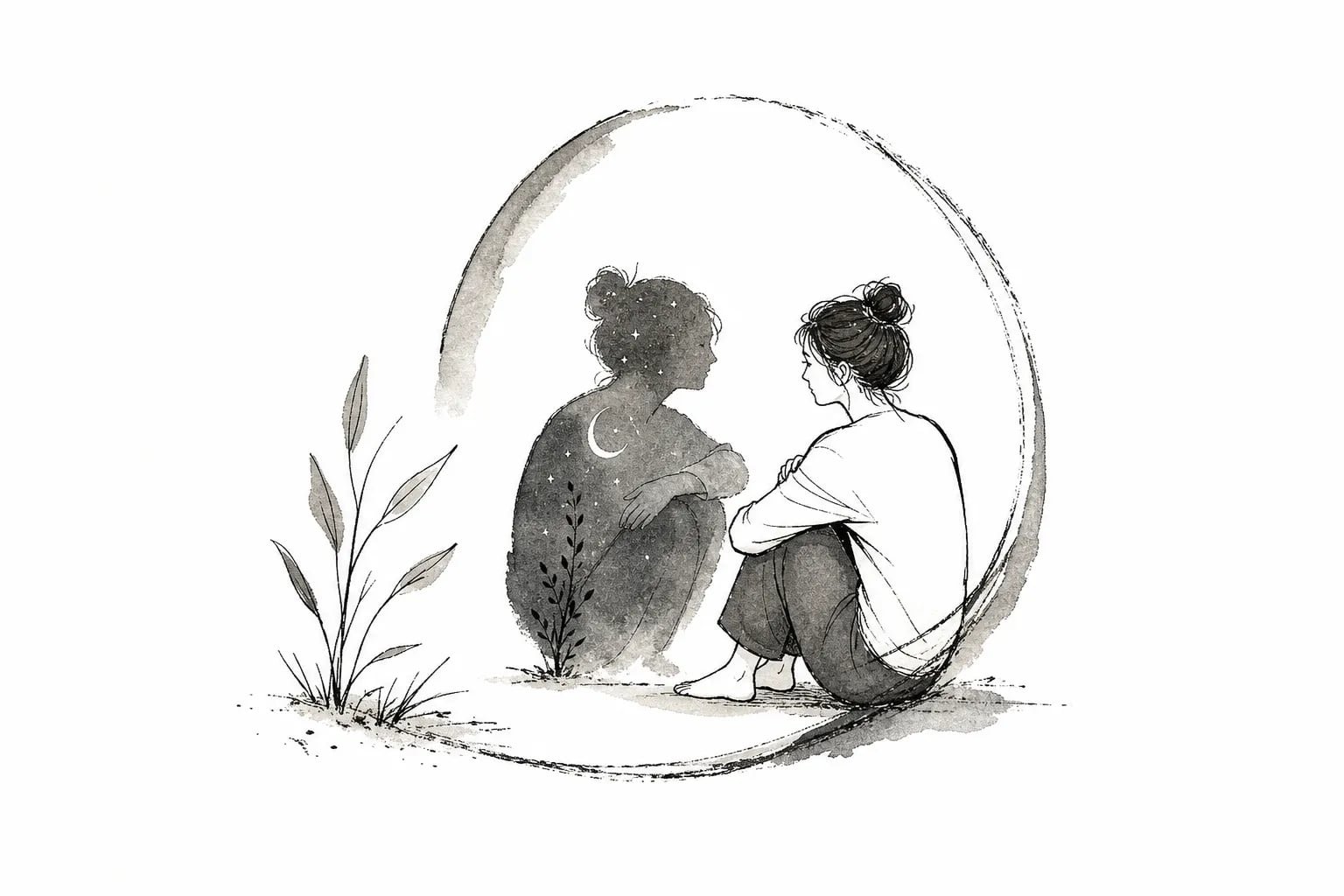
How does shadow work connect to spirituality? That question sits at the center of a tension many sincere seekers feel but rarely name. Most people pursuing spiritual growth focus on the light: the prayer, the practice, the disciplines, the gratitude. But genuine transformation rarely happens only in the well-lit rooms of the soul. What about the material buried beneath the surface? What about the emotions that don’t make it into Sunday’s journal entry, the reactions that surface at 2 a.m., the patterns that repeat no matter how sincerely you try to change them? Shadow work addresses exactly that territory. That territory is not separate from spirituality; it sits at the heart of it.
The connection between shadow work and authentic spiritual growth is not a fringe idea borrowed from pop psychology. It appears across Jungian analysis, contemplative Christian practice, and mystical traditions that predate Carl Jung by centuries. For readers who feel some tension around terms like “the shadow” or “inner darkness,” that tension is worth noting and setting aside for a moment. The concept is older than any modern framework. It describes something deeply human: the gap between who we present ourselves to be and who we actually are. Closing that gap is the work of a lifetime, and it is thoroughly spiritual. Biblical Tarot: Shadows of the Soul was designed specifically for that journey. Read on to understand the shadow’s role in spiritual growth and how to begin safely.
What the shadow self is and why it matters spiritually
The shadow self is the collection of traits, emotions, impulses, and capacities that you have learned not to identify with. Carl Jung described it as “the thing a person has no wish to be,” the negative side of the personality that the ego refuses to claim. But the shadow is not simply your worst qualities. It also holds unrealized strengths, buried creativity, and genuine gifts that were suppressed because they felt unsafe, unwanted, or simply too much for the people around you.
How Jung’s psychology describes the hidden self
According to Jung, the shadow forms throughout childhood as a direct result of social conditioning. Family expectations, cultural norms, and the basic human need for attachment all teach children which parts of themselves are acceptable. The parts that draw shame, correction, or withdrawal of love get pushed into the unconscious. They don’t disappear. They shape behavior, fuel overreactions, and drive relational patterns from just below the surface. Jungian shadow work is not about becoming the thing you repressed. It’s about knowing it exists, understanding where it came from, and reclaiming the energy that has been spent keeping it hidden.
How spiritual traditions frame the same idea
Contemplative Christianity has its own name for what Jung called the shadow: the false self. This is the persona we construct to feel acceptable before God and others, the version of ourselves that performs goodness rather than living from it. Mystics across traditions describe the necessary descent into one’s own depths as an inescapable part of the path to wholeness. From different vantage points, the psychological and the spiritual traditions are describing the same human experience: we cannot grow into our full selves while pretending parts of ourselves don’t exist.
How does shadow work connect to spirituality and awakening?
Spiritual awakening does not exempt anyone from shadow work. In many cases, it intensifies the need for it. As spiritual awareness expands, what was previously buried tends to surface with more force. This is sometimes called shadow material rising for integration, the unconscious pressing against the edges of awareness. The deeper someone goes spiritually without addressing the shadow, the more likely they are to plateau, project their unresolved pain onto others, or perform a sanitized version of growth that eventually collapses under its own weight.
The problem of spiritual bypassing
Spiritual bypassing is the practice of using spiritual language, frameworks, or disciplines to avoid the harder emotional and psychological work of inner healing. Many clinicians and teachers note that it is more common than people tend to acknowledge. Constant positivity that functions as a cover for unprocessed grief is bypassing. Forgiveness language that skips genuine acknowledgment of harm is bypassing. The language of surrender used to avoid setting necessary boundaries is bypassing. Shadow work is the antidote because it requires you to stop spiritualizing your way around pain and actually sit with what is there. It interrupts avoidance at the root.
What shadow integration actually does for spiritual development
The International Association for Analytical Psychology describes integration as a process that expands consciousness, creates new meaning, and releases energy that was previously spent fighting what you refused to see. Qualitative studies and practitioner accounts describe this as a kind of return, a revival of hope and the feeling of actually inhabiting one’s own life. For spiritual development, shadow work integration tends to reduce the compulsion to project pain outward. It builds emotional resilience and makes spiritual practice feel inhabited rather than performed, with a growing capacity to hold ambiguity in yourself and in the people around you. Shadow work frees you to be spiritually present rather than spiritually defended.
The biblical thread running through shadow healing
Shadow integration is not foreign to biblical faith. It is woven through the entire arc of scripture. The Bible does not present spiritual maturity as the absence of darkness. It presents it as the transformation of darkness. Redemption is, at its core, a shadow-work concept: the broken, rejected, and disowned parts of a person being brought back into wholeness and purpose. This is the story the Bible tells, again and again, in different voices and across different centuries.
Redemption, self-examination, and wholeness in scripture
Many readers and teachers treat the Psalms as a form of spiritual journal that models raw emotional disclosure offered directly to God, unfiltered and uncleaned. Grief, rage, shame, and longing all appear on those pages without apology. Psalm 139:23-24 asks God to search for hidden motives and grievous ways. Jeremiah 17:9 names the heart as deceitful and in need of honest examination. The prodigal son’s descent into his own ruin was not a detour from his story. It was the necessary passage that made his return possible. The New Testament language of dying to self, picking up one’s cross, and being transformed by the renewing of the mind all carry the same underlying logic: you cannot transform what you refuse to face.
How Biblical Tarot: Shadows of the Soul bridges two worlds
According to its creators, Biblical Tarot: Shadows of the Soul is a 79-card system that pairs Jungian shadow work with biblical narrative, placing scripture alongside each card to guide inner reflection rather than fortune-telling. For readers who have felt caught between meaningful psychological practice and Christian faith, the deck offers a way to hold both without compromise. It doesn’t ask you to choose between Carl Jung and the Gospel. It shows how the same human story appears in both. Whether you come to this work as a shadow work practitioner wanting biblical depth, or as a Christian seeking a spiritually grounded tool for genuine inner healing, the deck was designed with that exact tension in mind.
Signs your shadow is quietly blocking your spiritual growth
These signs are not failures. They are invitations, moments where the shadow is pointing toward something that needs attention. What looks like a spiritual struggle is often a shadow integration issue in disguise. Recognizing these patterns is the first step toward working with them rather than against yourself.
Projection, triggers, and repeated relational patterns
When someone reacts with unusual intensity to a trait in another person, they are often reacting to a disowned version of that trait in themselves. This is projection, and it is one of the shadow’s primary communication methods. Triggers follow the same logic: they are not random emotional reactions. They are the shadow knocking, asking to be heard. Repeated relational patterns are another sign. If the same argument surfaces in every relationship, if the same emotional dynamic appears across entirely different people and contexts, shadow material is likely running the show beneath the surface.
What genuine integration looks and feels like
Integration doesn’t mean the shadow disappears. It means it no longer operates in secret. Practitioners report practical signs of genuine integration: less reactivity in situations that previously felt explosive, more self-compassion in moments of failure, and a spiritual practice that feels lived rather than performed. There is also a growing ease with ambiguity in yourself and in the people you love. The difference between performing growth and living it becomes clear, and the gap between them starts to close.
Safe, practical inner shadow work practices to begin
Shadow work is not about forcing emotional intensity. Trauma-informed approaches start small, stay grounded, and include clear stopping points. The goal is consistent, sustainable contact with the material, not dramatic excavation in a single sitting. Starting gently is not weakness. It is how this work holds over time.
Trauma-informed precautions before you start
Ground your body before each session: slow breaths, a sensory check-in, feet flat on the floor, and a moment of stillness before you open the journal. Set a timer for 10 to 15 minutes and commit to stopping when it goes off, even if the writing feels unfinished. Choose one prompt or one trigger per session, not a list.
End with a closing ritual that signals to your nervous system that the session is complete: close the journal, step outside, make tea, or take a brief walk. Readers with untreated trauma, active dissociation, or PTSD history should approach this work alongside a trauma-informed therapist rather than alone. That is not a caveat. It is the recommendation widely shared by trauma-informed clinicians and guides across this field.
Shadow work journaling prompts and starter exercises
These five exercises are designed for beginners. Each one opens a door without forcing you through it.
- Trigger mapping: Write down a recent strong reaction, what happened in your body when it occurred, and what meaning you assigned to the event. Look for the gap between what happened and how large your response was.
- Projection noticing: List traits in others that provoke strong judgment or unusual admiration, then ask honestly whether those qualities live anywhere in you.
- The body scan prompt: Identify where tension lives in your body when you think about a recurring struggle. Journal about what that place might be holding and what it needs.
- The one honest sentence: Complete the phrase “Something I would never admit about myself is…” and sit with what surfaces without editing it away.
- The inner-part dialogue: Write a short letter from the part of you that you most judge or hide. Ask it what it needs, what it fears, and what it has been trying to protect you from.
For readers who want a structured, scripture-rooted container for these shadow work integration exercises, Biblical Tarot: Shadows of the Soul includes guided spreads and biblical reflection points designed specifically for this kind of inner work. The deck turns each of these prompts into a contemplative practice grounded in the same story the Bible has been telling all along.
The journey toward wholeness is worth taking
Shadow work and spirituality are not in tension with each other. They are two ways of describing the same journey toward wholeness. Across traditions, in Jungian psychology and in the biblical story, genuine inner growth requires meeting the parts of yourself you would rather not see. Suppression does not produce freedom. Integration does.
Understanding how shadow work connects to spirituality opens something that no amount of surface-level practice can reach. The shadow self is real and spiritually significant. Spiritual awakening and integration are deeply intertwined: awakening frequently surfaces shadow material rather than dissolving it, and biblical faith carries its own rich language for this interior work. The practical tools to begin are simpler than most people expect. You do not need a breakthrough moment or a dramatic revelation. You need a quiet space, an honest prompt, and the willingness to look.
For readers who want a tool that holds both the psychological and the scriptural together in one place, Biblical Tarot: Shadows of the Soul was built for exactly this work. It meets you where contemplative faith and honest inner work overlap, which is precisely where the most meaningful growth tends to happen. Your next step is closer than it feels, and it begins with the same willingness that brought you here.