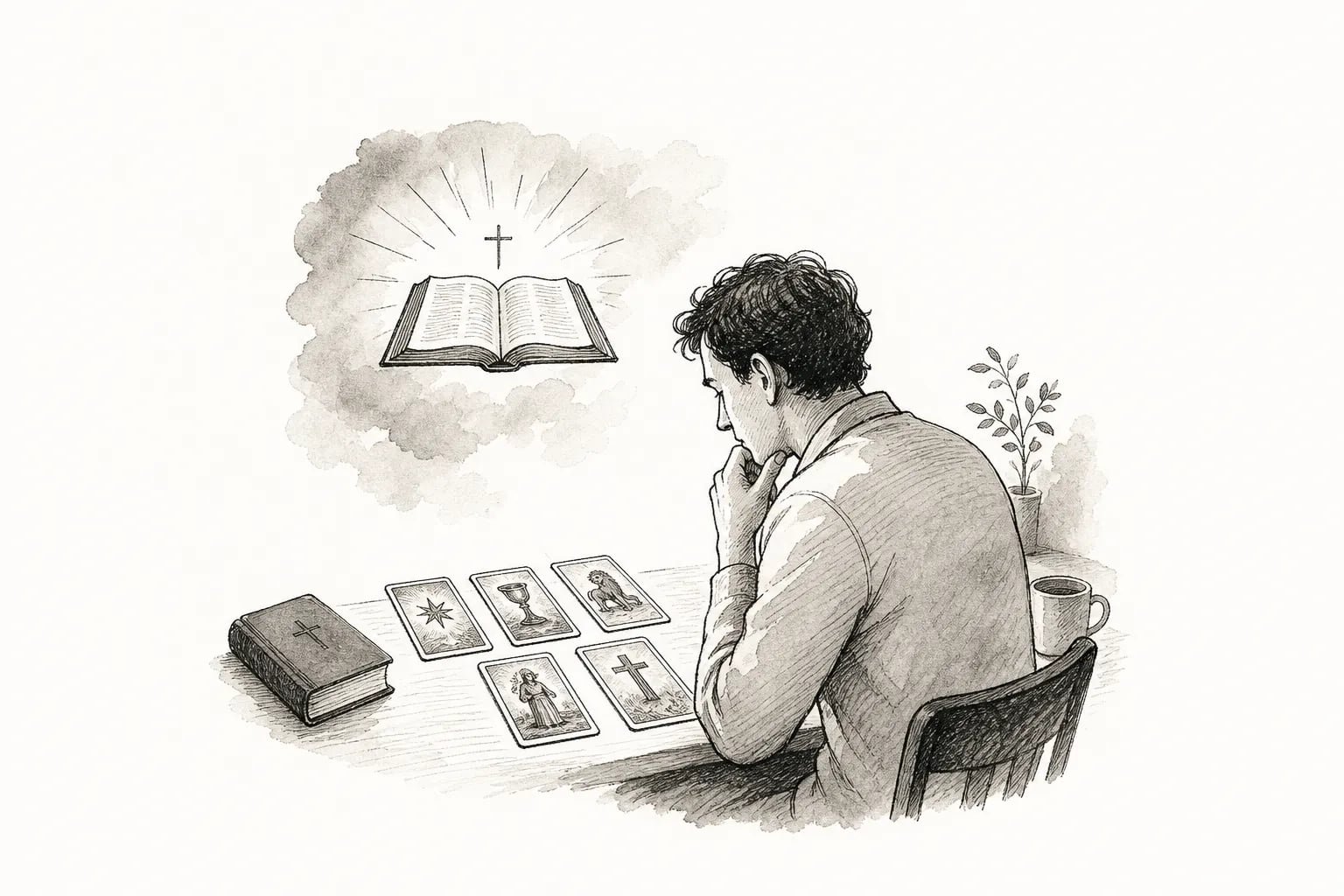
There’s a specific kind of tension that shows up for a lot of Christians: you’re drawn to tarot as a self-reflection tool, you’ve seen how other people use it to process their inner lives, and yet something in you hesitates. Your faith matters. The biblical warnings feel real. So you set the idea aside, even though the restlessness doesn’t go away. If you’ve been wondering whether biblical tarot can serve as a faith-compatible reflection tool, you’re not alone, and the answer is more grounded than you might expect. Scripture-based tarot takes the 78-card structure most modern decks follow and rebuilds it entirely around biblical narrative, replacing esoteric symbolism with the stories your faith is already rooted in.
When people start searching for a faith-compatible Christian tarot deck, Biblical Tarot Decks is the name they keep encountering, and for good reason. It’s one of the only publishers working at the specific intersection of Christian formation and card-based reflection. By the time you finish reading, you’ll understand what the practice actually is, how the deck works both mechanically and theologically, and whether it belongs in your spiritual toolkit.
What biblical tarot actually is, and what it isn’t
At its core, a scripture-based tarot deck takes the same 78-card framework that almost every modern tarot deck uses and reframes every card through a Christian lens. The Major Arcana, the Minor Arcana, the suits, the court cards, all of it stays structurally intact. What changes is the symbolic language. Instead of drawing from esoteric, Kabbalistic, or New Age tradition, each card is anchored in a biblical character, story, or scripture passage. The imagery tells a story from the Bible. The meaning flows from that story.
This is not a divination tool. That distinction is foundational, and it’s worth being direct about it. A biblical tarot deck is designed for reflective self-inquiry, the same way a lectio divina reading uses scripture as a mirror for what’s happening in your inner life. No card predicts anything. No card tells you what will happen. Each card surfaces a question worth sitting with, framed through a passage of scripture and the narrative that comes with it.
Scripture isn’t decorative in this system. It’s structural. The Bible story or passage assigned to each card shapes its entire interpretive layer. When you draw a card, you’re being invited into a piece of biblical narrative and asked what it illuminates about your situation right now. That gives the practice genuine theological weight rather than treating faith as a surface-level add-on to a secular tool.
How Rider-Waite symbolism carries biblical meaning
The Rider-Waite system was developed in 1909 by Arthur Edward Waite and illustrator Pamela Colman Smith. Before it, the Minor Arcana cards in most decks were essentially pips: four cups, seven swords, minimal imagery. Rider-Waite changed that by putting a fully illustrated scene on every single card, making the deck readable through image and story rather than abstract symbol. That shift turned tarot from a specialized practice into something broadly accessible.
Biblical narrative and the Rider-Waite structure
That story-driven structure is exactly what makes Rider-Waite such a natural fit for a biblically grounded deck. Biblical narrative is one of the richest storytelling traditions in human history. When every card already contains a scene, a posture, and a moment, it becomes straightforward to map those visual elements onto a parallel scene in scripture. The Tower card, showing a structure struck by lightning and people falling, maps directly onto the Tower of Babel: human ambition, overreach, and collapse. The Hanged Man’s posture of surrender maps onto Christ’s crucifixion. Death, in Rider-Waite, has never primarily been about ending; it depicts transformation, which maps cleanly onto resurrection.
Other scripture pairings from the deck make the logic visible. The Fool, depicting someone stepping into the unknown, is paired with Isaiah 43:19, the passage about God doing something new. The Hermit’s solitude maps onto Moses in the wilderness, wisdom forged through isolation. The Lovers connects to Adam and Eve, to choice, to the weight of moral decisions made in relationship. Each pairing isn’t arbitrary; it’s selected because the biblical story illuminates something the card archetype has always been reaching toward. Read in sequence, the 22 Major Arcana trace a journey from call through collapse and into restoration, which gives a devotional card practice its depth beyond pulling a single card each morning.
Biblical tarot: what to expect in the 78-card deck
If you’re considering purchasing a faith-based tarot card deck, you need specifics. The Biblical Tarot Decks product is a 78-card deck printed at full size, 4.75 by 2.75 inches, on premium cardstock. The cards are flexible, glossy, and sturdy enough for regular use without warping. High-detail print is part of the product specification, and buyer feedback consistently highlights the artwork as one of the deck’s strongest attributes, with words like bold and stunning appearing frequently in responses.
Biblical tarot deck contents
The deck comes with a printed guidebook that covers upright and reversed meanings for each card, a summary of the related biblical story, and spread options for structured reflection. Some editions also include an interactive e-book companion titled The Divine Patterns of Biblical Tarot. The guidebook is genuinely part of the practice rather than supplementary packaging; it provides the scriptural context that gives each card its meaning.
Biblical Tarot Decks offers two distinct products. The Original Biblical Tarot Deck is built for general spiritual reflection and works well as a starting point for anyone new to card-based devotional practice. The second deck, Biblical Tarot: Shadows of the Soul, is a 79-card system designed specifically for shadow work and inner healing, mapping biblical narrative onto more difficult interior territory, hidden emotions, unrealized potential, and the parts of yourself that are harder to look at directly. Your choice between the two depends on what you’re actually trying to do with the practice.
The theological questions worth taking seriously
The most common concern Christians raise when they encounter any tarot product is grounded in Deuteronomy 18:9, 14, along with related passages in Leviticus and Isaiah. These passages condemn divination, omens, and attempts to access hidden or future knowledge through supernatural means. Many Christian theologians apply this prohibition broadly to tarot, and that position deserves to be taken seriously rather than dismissed. The concern is real, it’s biblically sourced, and it’s held by thoughtful people.
Reflection vs. divination: where the line falls
The response from reflection-based practitioners turns on intent and mechanism. The biblical prohibition targets practices that seek hidden knowledge or future information outside of God, which is what divination actually is. When a card functions as a contemplative prompt tied to a scripture passage, the mechanism is entirely different. You’re not asking what will happen. You’re asking what this image and this biblical story illuminate about where you are right now. That’s the same function served by journaling, lectio divina, or praying through a psalm. The source of meaning is your own prayerful reflection, not a supernatural revelation from the cards.
Formal denominational endorsements for card-based reflection tools are limited, and it’s more honest to acknowledge that than to overstate the case. Bethel Church addressed a related controversy by defending the use of scripture-grounded cards as legitimate when the practice is biblically anchored and theologically intentional. The broader theological conversation is ongoing, which is itself an argument for using a deck built explicitly on scripture rather than a secular deck with a Christian interpretation layered on top afterward. The design of the tool matters when the theological question is this specific.
Who this practice is built for
The primary person this deck was designed for is someone who has felt drawn to tarot for self-reflection but couldn’t reconcile that pull with their faith. You don’t need to abandon your biblical worldview to use a scripture-based reflection tool. Every card in the Biblical Tarot Decks system is built explicitly on the story and passage most relevant to that card’s archetype, which means the faith-curious Christian or the lapsed believer returning to their roots has a clear path into the practice without theological compromise.
The audience extends further than that, though. People already doing shadow work or therapy-adjacent inner healing often find that a deck with genuine theological depth adds a dimension secular decks can’t offer. Christian counselors and pastors looking for visual, scripture-anchored tools for client sessions have used card-based reflection effectively in pastoral care contexts. Spiritual directors who incorporate contemplative practices into their work find that a card prompt can open a conversation that traditional formats don’t always reach. The publisher designs both decks specifically around these use cases.
How to begin your first devotional card practice
The simplest entry point is a three-card devotional spread you can complete in five minutes before the day gets away from you. Draw one card for where you are right now. Draw a second for what scripture is speaking into that situation. Draw a third for what a faithful step forward looks like. Nothing more is required. You don’t need a ritual, candles, or ceremony. You need a deck, your guidebook, and about five minutes of honest attention.
The core rhythm of a session is straightforward: look at the card’s imagery, read the scripture pairing in the guidebook, then write one honest response to the question the card raises. What does this story have to do with what I’m carrying right now? Where do I recognize myself in this passage? What does the image make me want to look away from? The practice is built for that kind of direct, unglamorous honesty, which is exactly where genuine soul work happens.
If you’re ready to start, Biblical Tarot Decks is the place to find a deck built for exactly this kind of practice. Whether you begin with the Original Biblical Tarot Deck for general reflection or go straight to Shadows of the Soul for deeper interior work, both decks include the guidebook support you need to begin well.
Is a scripture-based tarot deck right for you?
The question that opened this article was whether biblical tarot is legitimate and compatible with Christian faith. The honest answer is that it depends on how the deck is built and how it’s used. A deck grounded in scripture, designed for reflection rather than prediction, and mapped card by card to biblical narrative is a fundamentally different object from a secular divination tool. The two things don’t belong in the same category, even if they look similar from the outside.
Biblical Tarot Decks exists at that specific intersection. It’s the only publisher currently offering tarot systems built explicitly to reframe every card through Christian story and scripture, not as an afterthought, but as the design principle the entire deck is organized around. If you’ve been sitting with the tension between your faith and your desire for a meaningful self-reflection practice, this is where that tension was waiting to take you.
Reach out to the Biblical Tarot Decks team directly if you have questions about which deck fits your situation. Both decks are available to explore, and the team is built around supporting exactly the kind of person this deck was made for: faith-curious, spiritually serious, and ready to do the work.