
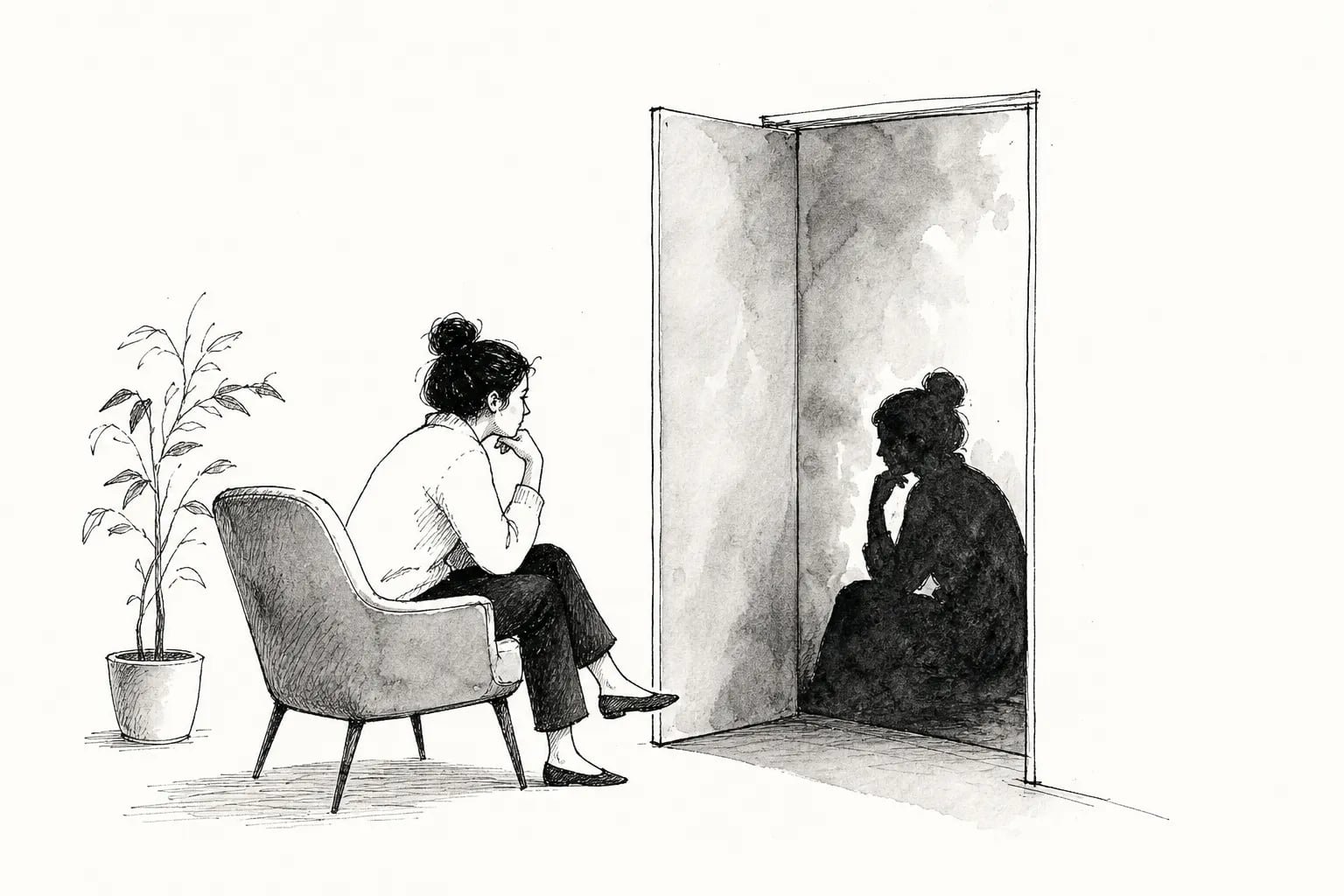
Shadow work for beginners starts with a simple but uncomfortable recognition: there are parts of yourself you sense but can’t quite face. Maybe it’s a flash of anger you swallow before anyone sees it, a streak of envy you immediately feel guilty about, or a pattern of self-sabotage you can’t seem to break no matter how hard you try. These aren’t character flaws. They’re shadow material, and they’ve been waiting for your attention.
Shadow work is the self-reflection practice that helps you bring those hidden parts into awareness so they stop running your life from the background. It draws from Carl Jung’s concept of the shadow, the collection of traits, emotions, and impulses the ego pushes aside because they weren’t safe or acceptable to express. While shadow work is not a replacement for licensed therapy, it is a structured, self-directed practice rooted in curiosity rather than judgment. It’s not something to fear, though it can produce genuine discomfort, and for some people, it surfaces material that benefits from professional support. More on that later.
Starting this journey is easier with a framework. Some people begin with a journal. Others use a structured book or a reflective deck built specifically for inner healing. This guide covers a clear definition of shadow work, why it matters for your daily life, a concrete 6-step routine you can use this week, ready-to-use journaling prompts, and honest guidance on when to bring in professional support.
What shadow work actually is (and where the concept comes from)
Carl Jung described the shadow as the parts of personality the ego refuses to own. Not because those parts are purely evil, but because at some point in your development, expressing them felt dangerous, unacceptable, or simply not allowed. A child praised only for being calm may bury her anger. A boy told that ambition is arrogance may suppress his drive. Those qualities don’t disappear. They go underground.
The shadow contains both dark and disowned light. Suppressed anger lives there, yes, but so does unexpressed confidence, buried creativity, and assertiveness that was shamed out of you early on. Jung’s insight was that these rejected parts don’t vanish from the personality. They drive behavior from the unconscious until something brings them into awareness.
The goal of shadow work is not to eliminate these parts but to integrate them. Integration means acknowledging them, accepting them as part of the whole person you are, and finding healthier ways to let them exist consciously. This is self-exploration, not clinical treatment, and that distinction matters when you’re just starting out.
How the shadow quietly runs your daily life
The clearest evidence that shadow material is active is a disproportionate emotional reaction. When someone’s confidence irritates you far beyond what the situation warrants, that irritation is worth examining. What you react to sharply in others is often something you’ve suppressed in yourself. Jung called this projection: the shadow quality gets attributed to someone else because you can’t yet see it in yourself.
Think about a coworker whose assertiveness makes you bristle. If you grew up in an environment where speaking up brought punishment or disapproval, assertiveness may have become an internal forbidden zone. Seeing it expressed freely in someone else triggers that suppressed material. The irritation isn’t really about them. It’s a signal pointing back at something you haven’t been allowed to claim.
This shows up in recurring relationship conflicts, patterns of self-sabotage just before a breakthrough, and the persistent sense that you keep making the same mistake with different people. When you begin paying attention to these signals, reactions gradually become less automatic. Triggers lose some of their charge. You start to notice the pattern before you’re already inside it. This is a long-term benefit, not an overnight fix, and setting that expectation now will keep you from quitting too early.
Shadow work for beginners: a 6-step starter routine
A safe beginner shadow work routine is short, structured, and time-limited. Plan for 10 to 15 minutes per session, roughly two to three times per week, though if you’re new to emotional self-examination or prone to overwhelm, starting with one or two sessions per week is a reasonable, lower-pressure alternative. Use a timer. Follow these six steps in order, especially in your first few weeks.
Steps 1 to 3: ground, observe, and name
Step 1, ground: Before you write a single word, spend one to three minutes breathing slowly and deliberately. Grounding your nervous system before you enter emotionally charged material prevents flooding, that overwhelmed state where emotion moves faster than your ability to process it. A simple slow-breathing practice, where the exhale is noticeably longer than the inhale, is enough. This is not optional or decorative.
Step 2, observe with a trigger log: Write down one moment from your day when you felt unusually upset, ashamed, jealous, or irritated. Stick to facts only at this stage. What happened? What did you feel? What did you notice in your body: tightness in the chest, heat in the face, heaviness in the stomach?
Step 3, name the emotion precisely: Move past “I felt bad” or “I was upset.” Label the feeling accurately. Was it shame? Resentment? Fear of rejection? Humiliation? Naming creates psychological distance between you and the emotion. It shifts you from being the feeling to observing it, and that small shift is where awareness begins.
Steps 4 to 6: trace, check for projection, and integrate
Step 4, trace it back: Ask yourself when you felt something similar before, especially in earlier relationships or in childhood. You’re not looking for a definitive answer. You’re looking for patterns. Write whatever comes up without editing it.
Step 5, check for projection: Ask what quality in the other person or situation triggered you. Then ask whether that quality is something you suppress, fear, or secretly want for yourself. This question is the engine of shadow work. The honest answers are often uncomfortable, and that discomfort is a sign you’re on the right track.
Step 6, integrate with one small action: Choose a single low-stakes action that reflects the insight you’ve reached. Set a boundary you’ve been avoiding. Name a need out loud. Practice the quality you’ve been hiding in a safe, private context. Integration is not just intellectual. It requires behavior, even if the behavior is small. End every session deliberately: stretch, drink water, take a short walk. Return your attention to the present before moving on with your day.
Shadow work for beginners: journaling prompts to use this week
Journaling is where shadow work becomes concrete. The prompts below are designed for beginner shadow work practice. Pick one per session, set a timer for ten minutes, and write freely without stopping to revise. The goal is honest observation, not polished insight.
For your daily sessions, start with these trigger-focused prompts:
- What did I have a strong emotional reaction to today?
- What’s underneath that reaction?
- When have I felt this before?
- What did I judge in myself today?
- What did I judge in someone else today?
Once a week, set aside thirty to forty-five minutes to reread your daily entries and look for recurring themes. Use these weekly prompts to guide that review:
- What triggers showed up more than once this week?
- What quality in others kept bothering me, and do I suppress that quality in myself?
- What do I keep avoiding admitting?
- What would I need to feel safe enough to express the part of me I’ve been hiding?
The purpose of the weekly review is pattern recognition, not diagnosis. You’re looking for themes that recur, not drawing firm conclusions about who you are. Observation comes before interpretation, always. When you try to interpret too quickly, you risk either over-reading the material or shutting down the process with self-judgment.
Tools for shadow work for beginners
A good shadow work tool does three things: it provides structure so you’re not starting from a blank page, it uses symbolism or narrative to bypass the part of the mind that defends and rationalizes, and it keeps you grounded rather than sending you into a spiral. Two foundational text-based options worth knowing are Kathleen Adams’s Journal to the Self, which offers a practical toolkit of structured prompts, and researcher James Pennebaker’s work on expressive writing, which found that writing about emotionally significant events produces measurable psychological benefit over time.
For beginners who want a richer, spiritually grounded entry point, reflective card decks designed for inner healing offer something distinct from a blank notebook. Biblical Tarot: Shadows of the Soul from Biblical Tarot Decks is a card-based system built around shadow work and inner healing themes. Each card pairs a shadow-relevant emotion or behavioral pattern with a biblical story and scripture passage, giving you a narrative entry point into difficult emotional territory rather than an open-ended prompt that can feel overwhelming when you’re starting out. (Note: Biblical Tarot Decks is the publisher of this guide.)
This approach is particularly suited to readers who come from a Christian background or who want a spiritually grounded framework to hold the weight of what shadow work surfaces. The biblical stories embedded in each card carry centuries of human experience with fear, shame, betrayal, grief, and redemption. That depth makes the reflection feel less like staring into a void and more like entering a conversation with scripture, tradition, and accumulated human experience.
Use the deck as a companion tool alongside the journaling routine above, not as a replacement for it. The deck surfaces the material; the writing does the integrating. If you prefer a secular approach, structured journaling kits or prompt-based workbooks serve the same scaffolding function.
When to slow down, pause, and ask for professional help
Shadow work is meant to produce manageable discomfort, not destabilization. Mild emotional unease after a session is normal and expected. Persistent distress is not, and recognizing the difference early is part of practicing safely.
Signs that the work is moving too fast include emotional overwhelm that lasts more than a day or two after a session, flashbacks or intrusive memories that appear during or after journaling, shame spiraling that worsens rather than settling, and dissociation during exercises or difficulty returning to a grounded state once the session ends. When any of these appear, substantially shorten your sessions, even a few minutes is enough, use only one structured prompt, and spend more time on grounding before and after the writing.
There are situations where solo shadow work is not enough, and naming them clearly is more helpful than leaving them vague. Involve a licensed therapist if you notice trauma symptoms intensifying, including flashbacks, nightmares, or body memories. Seek support immediately if suicidal thoughts or self-harm urges appear. If your sleep, appetite, work, or relationships deteriorate over more than a few days following shadow work sessions, that is a clear signal to pause and get professional guidance. The same applies if you are managing bipolar instability, active addiction, severe anxiety or depression, or any other condition that makes the material feel unmanageable on your own.
Seeking professional support is not a sign that shadow work went wrong. A trauma-informed therapist is a partner in the process. The work doesn’t stop; it just gets the support it deserves.
Start with one honest question
Shadow work for beginners comes down to one core principle: approach yourself with curiosity, not judgment. The goal is integration, becoming more whole, not becoming perfect. The six steps above give you a repeatable structure: ground, observe, name, trace, check for projection, and integrate with one small action. That sequence is enough to begin.
The right tools make a real difference. Whether you start with a journal, a structured book, or a spiritually grounded reflective deck like Biblical Tarot: Shadows of the Soul, having a framework turns an idea that can feel overwhelming into a practice that fits inside fifteen minutes. The framework holds you while the work unfolds.
Start with one session this week. Pick one prompt. Write for ten minutes, letting the words move without self-correction. See what shows up. The shadow work journey doesn’t begin with a grand gesture. It begins with one honest question, followed by the willingness to sit with the answer.